The Intelligence Timeline: How We Got Here
The Silent Squeeze & The Denial Playbook
Carriers use algorithmic downcoding to underpay without formal denials — relying on the fact that your team is too busy to fight 10,000 small underpayments.
The Prior Auth Trap & The TPL Identification Gap
Carriers weaponize missing authorizations, and a $312 write-off is often a $3,900+ Third-Party Liability (TPL) recovery hiding in plain sight.
The Workers' Comp Ghost Denial
We mapped the 50-state risk of timely filing deadlines — where the clock is used as a silent weapon to bar valid claims before they can be appealed.
The "Plausibility" Wall
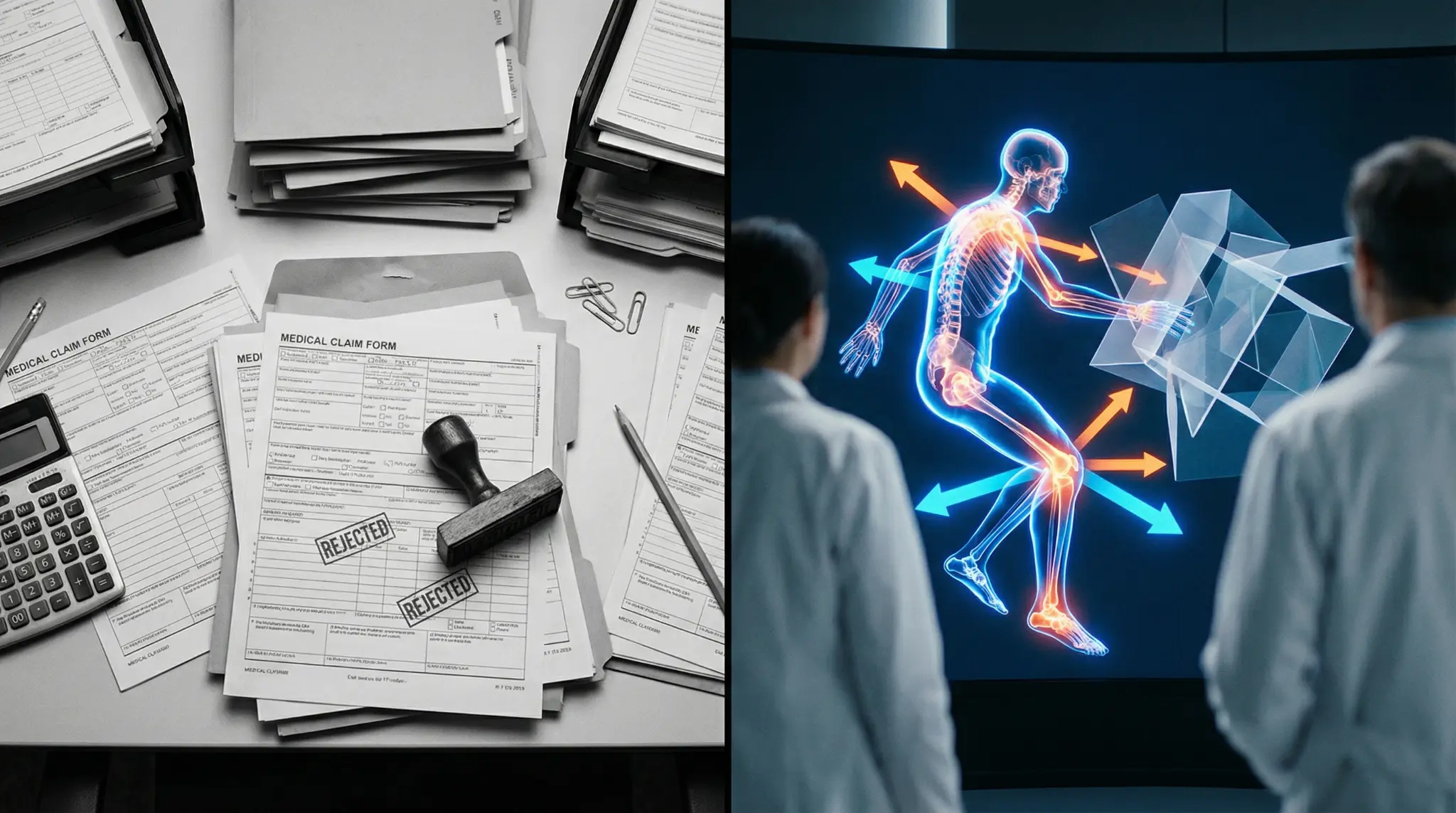
In 2026, payers aren't just saying "No." They are saying: "The Mechanism of Injury does not match the clinical presentation." They are deploying AI to compare accident scene photos with medical records and argue that a "low-speed" impact couldn't possibly cause a spinal injury.
This is where legacy RCM fails. You cannot fight physics with a standard appeal letter. The payer's AI is generating denial rationale in milliseconds — your team is responding with narrative text written days later. The asymmetry is structural.
ClaimCalcPro — Turning Chaos Into Clarity
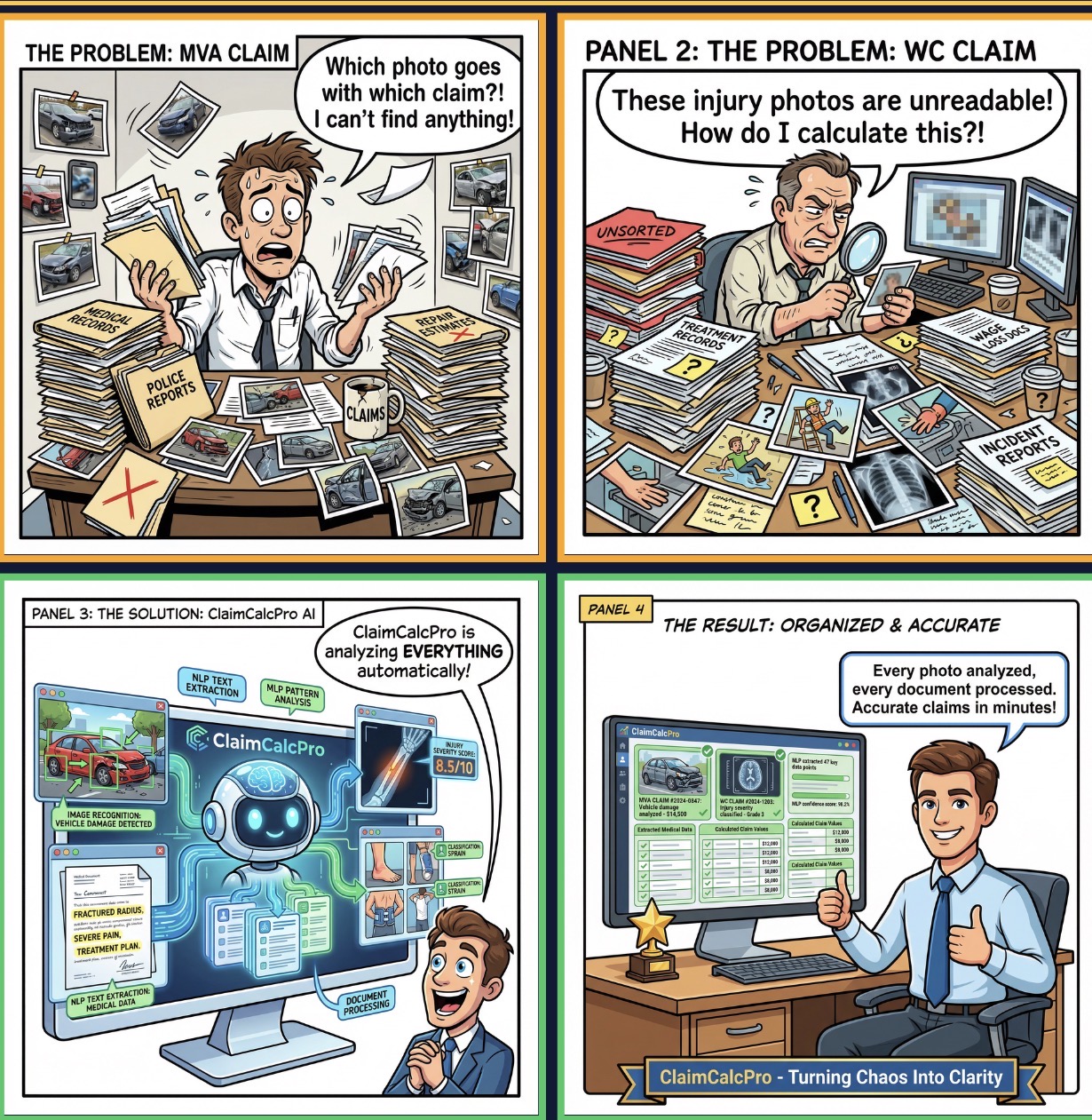
Panel 1: The MVA claim problem — scattered photos, police reports, medical records with no organization. Panel 2: The WC claim problem — unreadable injury photos, unsorted treatment records, impossible calculations. Panel 3: The solution — ClaimCalcPro AI performs NLP text extraction, MLP pattern analysis, image recognition, and document processing automatically. Panel 4: The result — every photo analyzed, every document processed, accurate claims generated in minutes.
Illustration: Product of Melissa Cousin · ClaimCalcPro™
GRIE™: The Missing Link in Complex Appeals
Built into ClaimCalcPro™ · Proprietary IP of Melissa Cousin
In complex MVA and Workers’ Comp claims, the challenge is often not identifying the diagnosis. The challenge is proving the connection between the incident, the injury pattern, and the billed care in a way that stands up during review.
That is where GRIE™ becomes more than a visual feature. Built into the ClaimCalcPro™ workflow, GRIE™ uses photo reenactment and structured reporting to help teams document the Mechanism of Injury alongside the rest of the appeal record.
Many denials and disputes center on medical necessity, causation, or insufficient supporting documentation. A stronger appeal package does not rely on codes and notes alone — it combines clinical documentation with a clearer explanation of how the event plausibly produced the injury being treated. GRIE™ helps teams build that bridge.
GRIE™ is a structured evidence product, not a visualization tool. Standard records document what was treated. GRIE™ helps illustrate how the injury mechanism aligns with the treatment story and appeal rationale — supported by certified chain of custody, audit logging, timestamp verification, and transparent AI labeling. That is the difference between a claim that settles in 30 days and one that ages past 120.
Photo Reenactment
Scene photos and clinical narratives are transformed into structured anatomical reconstructions that illustrate how the reported mechanism aligns with the diagnosed injury pattern.
MOI Documentation Engine
GRIE™ generates structured MOI documentation with anatomical reconstruction visuals, illustrating how the reported incident mechanism aligns with the diagnosed injury. Visual evidence is labeled as an analytical support exhibit.
The Adjuster's 'Oh No' Moment
When an adjuster sees a physics-backed reconstruction instead of a wall of text, the 'low-impact' defense collapses. Visual authority ends the argument.
Forensic Credibility at the Billing Level
GRIE™ brings expert-witness-level reconstruction down to the daily billing workflow. It turns a standard RCM team into a forensic powerhouse — without adding headcount. Insurance adjusters spend seconds reviewing appeals. A GRIE™ photo reenactment is an immediate, high-authority visual that says: "This injury is physically undeniable."
Citations as Code™: Turning Evidence into Infrastructure
Proprietary IP of Melissa Cousin · ClaimCalcPro™
Why spend hours manually searching for the right case law or statute? Citations as Code™ treats legal and regulatory evidence like software — versioned, traceable, and automatically updated when statutes change. Every claim becomes a governed evidence package, not a loose collection of documents.
Dynamic Traceability
Every finding in your appeal is 'cited as code.' If a payer disputes a line item, they aren't arguing with a biller — they are arguing with a validated, timestamped citation from state-specific statutes or biomechanical standards.
Interoperable Evidence
Citations are built directly into the claim's metadata. If a claim moves to legal or collections, the chain of custody for the evidence is already complete — no reconstruction required.
Automated Regulatory Sync
Fee schedule updates, statute revisions, and payer policy changes are tracked and propagated automatically, so your citations never go stale.
The Chain of Custody Advantage
When a claim moves from billing to legal to collections, the evidence chain is already complete. No reconstruction. No "where did we put that statute?" Citations as Code™ means the moment a claim is created, its legal infrastructure is already built. This is the difference between a claim that settles in 30 days and one that ages past 120.
The ROI of the Forensic Shift
The ROI of GRIE™ and Citations as Code™ is not only recovered dollars. It is less labor per appealed file, faster package assembly, and stronger documentation consistency across teams. In practical terms: fewer hours gathering fragmented records, fewer weak appeals built on incomplete narratives, and better support for medical-necessity and causation arguments that payers examine closely. For clients, the value proposition is operational and financial — move complex MVA and WC claims through review with more defensible supporting evidence, reduce avoidable rework, and improve the quality of appeal submissions.
| Stakeholder | Pain Point Solved | Outcome |
|---|---|---|
| Hospital RCM | 120+ day aged A/R on MVA/WC claims | First-time-right evidence crashes the timeline |
| Hospital RCM | Medical necessity denials (#1 denial reason) | GRIE™ provides the 'Why' ICD-10 codes cannot |
| Legal / Attorneys | Low settlement values on soft-tissue cases | Visual MOI documentation strengthens injury narrative for settlement |
| Legal / Attorneys | High litigation costs on 'low-impact' defenses | Cases settle faster when defense sees structured anatomical reconstruction |
| Collections | No leverage beyond demand letters | Forensic proof of debt validity — not just a balance due |
Frequently Asked Questions
See GRIE™ and Citations as Code™ in Action
If you lead RCM, collections, or legal ops and want a safer way to recover "stranded" Workers' Comp revenue, start with a live 30-minute walkthrough. We'll show you exactly how GRIE™ and Citations as Code™ work on a real claim type from your specialty.
No commitment required · 30 minutes · Live demo on your claim type